What Is Porous Alumina Ceramics Used For?
Porous Alumina Ceramics are valued not simply for being lightweight, but for combining heat resistance with a network of open pores. That structure can let gas or liquid pass through while the ceramic withstands demanding temperatures and corrosive environments. In practice, a porous alumina component might sit inside a filtration unit, support a catalyst bed, or help distribute gas across a burner plate. The exact role depends on pore size, permeability, and strength.
The applications are varied. Porous alumina is used in industrial filtration, thermal insulation, catalyst supports, and some specialized electronic or laboratory components. Small details matter: a filter with pores that are too large may pass unwanted particles, while one with pores that are too small may restrict flow. A useful balance is not automatic. Designers must consider mechanical strength and cleaning requirements alongside porosity.
Raw-material scale provides context, but it is not a measure of this niche market. The International Aluminium Institute’s 2023 alumina production statistics report roughly 140 million tonnes of alumina output worldwide. That figure describes alumina production overall, not porous-ceramic output. The USGS Mineral Commodity Summaries 2025 also tracks alumina within the broader industrial materials supply chain. These sources help explain the material’s industrial relevance, but they do not prove demand for every porous-alumina application. This overview examines where Porous Alumina Ceramics are used, how their pore structure shapes performance, and what practical trade-offs buyers and engineers should assess. A pore is not a guarantee.
What Porous Alumina Ceramics Are
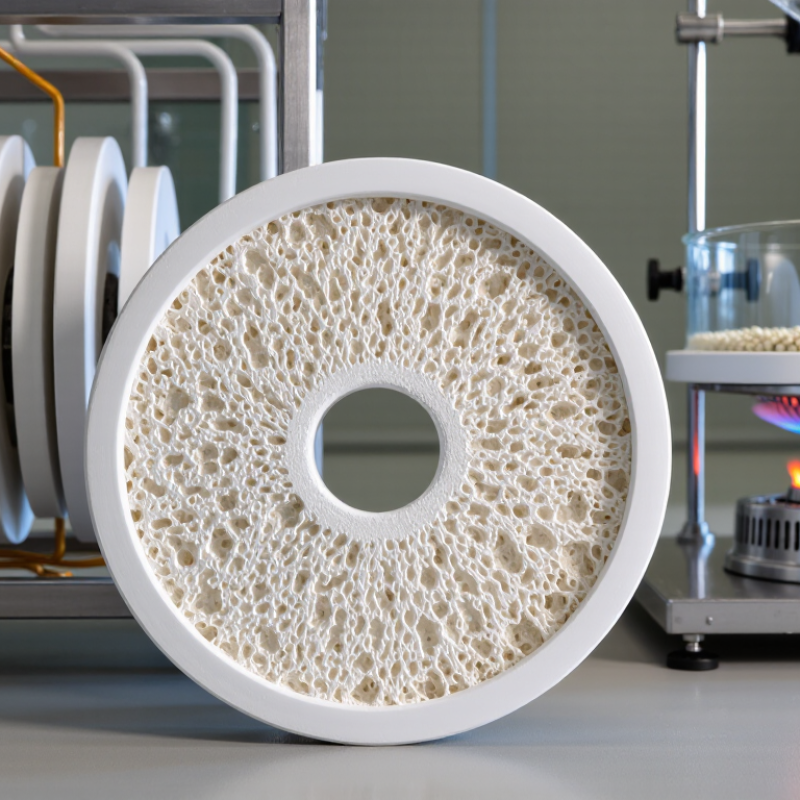
Porous alumina ceramics are rigid materials made mainly from aluminum oxide, with a network of tiny openings throughout their structure. Unlike dense alumina, they contain connected or isolated pores that reduce weight and allow fluids or gases to pass through, depending on how the material is made. Think of a pale, hard ceramic surface with fine channels inside. Some pores are visible under magnification; others are far smaller.
Manufacturers create these structures by mixing alumina powder with temporary pore-forming materials, then firing the shaped body. As those materials burn away, spaces remain in the ceramic. The firing temperature, powder size, and forming method affect pore size, strength, and permeability. It is a careful balance. More open space can improve flow, but may reduce mechanical strength. The result is not always perfectly uniform, either; small variations can matter in demanding applications. Engineers therefore assess both the pore structure and the intended operating conditions before selecting a grade. Porous alumina is valued for heat resistance, chemical stability, and controlled permeability, though its performance depends on its specific design.
Properties That Make Them Useful
What Is Porous Alumina Ceramics Used For?
Properties That Make Them Useful
Porous alumina ceramics combine a rigid ceramic framework with open or connected pores. This structure lets fluids and gases pass through while the solid body remains stable. In filtration systems, carefully selected pore sizes can help retain particles without blocking flow too quickly. The exact performance depends on pore distribution, wall thickness, and operating conditions.
Alumina also tolerates high temperatures and resists many corrosive environments. That makes porous components useful as filter elements, catalyst supports, and gas diffusers in industrial equipment. Their hard surfaces can withstand repeated contact with particles, though fine debris may still clog narrow passages. Not invincible.
The pores can reduce weight and slow heat transfer compared with dense alumina parts. This is useful where thermal insulation or controlled fluid movement matters. Engineers must balance porosity against strength: adding more voids often weakens the ceramic. A component may look sturdy, yet crack under impact or uneven heating. Testing under realistic flow, temperature, and pressure conditions is essential, since published material properties alone may not predict service life. The best design is not always the most porous one.
Applications in Filtration and Fluid Processing
Porous alumina ceramics are used in filtration systems where heat resistance and chemical stability matter. Their connected pores let fluid pass while retaining particles, depending on pore size and operating conditions. In a process line, a ceramic element may separate suspended solids from water, solvents, or hot gases. The exact result depends on the feed; no filter removes every contaminant.
In fluid processing, porous alumina can also serve as a diffuser, distributing gas through liquid as fine bubbles. This can support aeration, mixing, or controlled contact between phases. Its rigid structure tolerates demanding temperatures better than many polymer filters, though thermal shock and sudden pressure changes still require care. Small details matter. Engineers typically match pore structure to flow rate, particle size, and cleaning method, then verify performance under real process conditions. Ceramic media can be brittle, and fouling may reduce throughput over time. Cleaning can help, but it is not always enough. That limitation deserves attention when designing a system.
Uses in Thermal and Chemical Systems
Porous alumina ceramics are used in thermal systems where heat, airflow, and structural stability must be managed together. In a furnace, a porous panel can slow heat transfer while allowing gases to move through its interconnected openings. This can help distribute warmth around components or support controlled gas flow near a heated surface. The material also serves as a carrier for heating elements and as a support in high-temperature equipment.
Details matter. Pore size, wall thickness, and operating temperature affect performance. A fine-pored part may restrict flow more than expected, while a highly porous one can lose strength. Thermal cycling can also cause damage, especially when heating and cooling are uneven. It is worth checking the actual grade and test conditions, rather than assuming every alumina part behaves alike.
In chemical systems, porous alumina is used as a catalyst support, a gas diffuser, or a component in filtration and separation equipment. Its ceramic structure tolerates many hot, reactive environments, and its internal surface can hold active materials. For example, gas passing through a porous disc may emerge as smaller bubbles, improving contact with a liquid. Still, resistance depends on the chemical, concentration, and temperature. Strong acids or alkalis may attack some grades. Not universal. Careful compatibility testing is sensible before long-term use.
What Is Porous Alumina Ceramics Used For?
Pore-size classes help explain how porous alumina can be tailored for thermal and chemical systems. The chart shows IUPAC pore-width boundaries, not measurements of a particular ceramic.
How to read it: IUPAC classifies micropores as narrower than 2 nm, mesopores as 2–50 nm, and macropores as wider than 50 nm. Depending on its pore structure, porous alumina can serve as a catalyst support, filter, or thermal-insulation material. The suitable pore structure depends on the process and operating conditions.
How Pore Structure Shapes Application Choices
Porous alumina ceramics are used in filtration, catalyst supports, gas distribution, and thermal insulation. Their performance depends less on the word “porous” than on pore size, connectivity, and wall thickness. A fine, connected network can capture particles in a liquid stream; larger channels allow faster flow but may let smaller particles pass. Closed pores, by contrast, trap air and help limit heat transfer. Details matter.
A review by Studart and colleagues in the Journal of the American Ceramic Society (2006) describes macroporous ceramic processing across a broad porosity range, roughly 20–90% by volume. This is not a specification for every alumina part: higher porosity usually reduces strength, while narrow pore throats can raise pressure drop. For a filter, engineers should compare pore-size distribution and permeability, not rely on average pore size alone. For a hot-gas support, thermal cycling and mechanical load deserve equal attention. The trade-off is not always neat.
Tip: Match the pore network to the fluid, particle size, temperature, and operating pressure. Ask for measured porosity and permeability data, plus the test method. One sample can mislead. A small pore variation may change flow noticeably.