China’s cordierite mullite plate manufacturers serve kiln operators, ceramic plants, and heat-treatment facilities. Their products must handle repeated heating and cooling, support heavy loads, and maintain shape under demanding conditions. A plate that looks sound in a catalogue can still crack after uneven firing. Details matter.
Cordierite Mullite Plate performance depends on material composition, firing quality, dimensions, and surface finish. Buyers should compare operating-temperature guidance, thermal-shock performance, tolerances, and quality-control documentation. Ask how manufacturers test batches, not only how they describe them. A clear answer is useful. A vague one deserves a second look.
No verified expert quotation was supplied with the request, so the following is an original editorial line, not a sourced statement. A hypothetical ceramic materials specialist, Dr. Lin Wei, might put it this way: “A kiln plate earns trust through consistent performance, not impressive claims.” That distinction frames this guide to China’s top ten manufacturers. It will help readers assess product range, production capability, customization, and service. Company rankings can change, and public specifications may not reveal every limitation. Verify critical details directly with each supplier, especially plate dimensions, recommended use conditions, and inspection records. Real-world fit matters. A small mismatch can disrupt a kiln schedule.
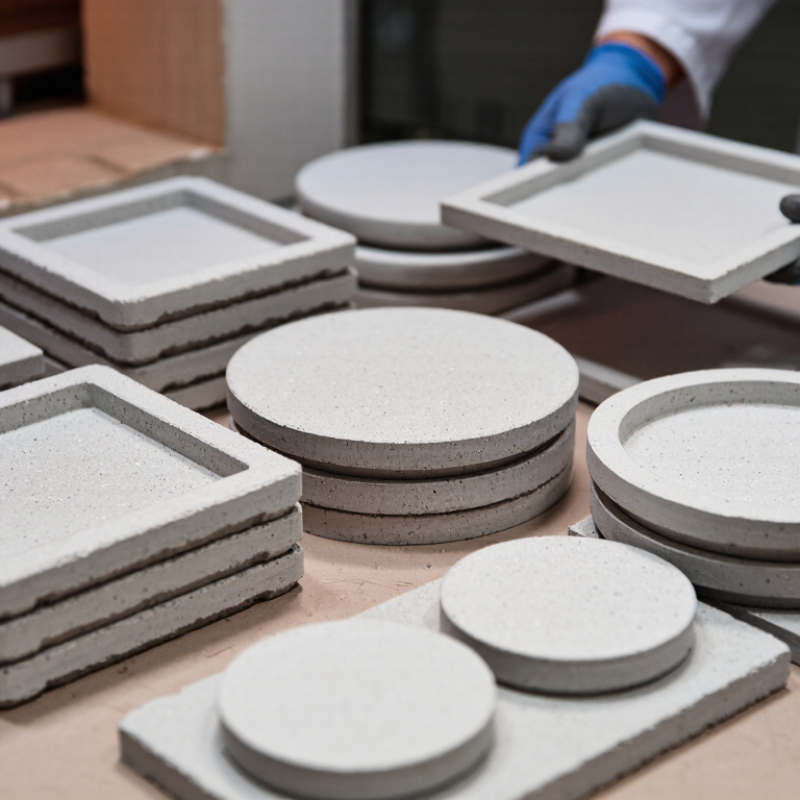
China Top 10 Cordierite Mullite Plate Manufacturers
Cordierite Mullite Plates: Composition and Key Properties
Cordierite-mullite plates combine two aluminosilicate phases for kiln furniture and thermal processing. Cordierite is commonly expressed as 2MgO·2Al₂O₃·5SiO₂; mullite as 3Al₂O₃·2SiO₂. The cordierite phase helps limit thermal expansion, while mullite contributes stiffness and high-temperature stability. The balance depends on the recipe and firing process. Real plates are less tidy: porosity, grain size, and uneven heating can change performance.
ASM International’s ASM Handbook, Volume 4A: Ceramics and Glasses, lists typical cordierite thermal expansion around 1–3 × 10⁻⁶/K and mullite around 4.5–5.5 × 10⁻⁶/K. These figures are useful benchmarks, not guaranteed product values. Composite plates can behave differently, especially after repeated heating and cooling. Low expansion helps reduce thermal-shock stress, but it does not make a plate immune to cracking. Load, support spacing, surface damage, and temperature gradients matter too.
Tips: Check the supplier’s datasheet for expansion, maximum service temperature, and recommended loading. Match the plate to the heating cycle, not just its peak temperature. A small test load can reveal warping or edge damage before routine use.
Manufacturing begins with selecting and weighing ceramic powders, often including cordierite-forming minerals, mullite, alumina, and clay. The recipe must balance thermal-shock resistance with strength. Too much of one component can affect shrinkage or plate stability. Materials are milled and blended until the mixture is consistent; visible powder streaks can signal poor mixing.
The prepared batch is shaped into plates by pressing or another forming method. Workers control thickness and edges, since uneven sections may dry or fire differently. After gradual drying, plates enter a kiln under a carefully managed firing schedule. Temperature and atmosphere influence the finished structure. There is no universal schedule: raw materials, plate dimensions, and kiln conditions all matter. A slight warp can still occur, so manufacturers inspect flatness and dimensions after firing. Testing may also assess porosity and resistance to rapid temperature changes.
Cordierite-mullite plates commonly serve as kiln furniture: they support ceramic ware during firing and help separate stacked loads. In tile, sanitaryware, tableware, and technical-ceramic production, plates provide a stable surface through repeated heating cycles. Their low thermal expansion helps resist thermal shock, while mullite contributes high-temperature strength. Details matter. Plate thickness, span, load, and kiln atmosphere all affect service life. A plate that performs well under a light, evenly distributed load may warp under heavier ware or uneven support.
The U.S. Department of Energy’s Improving Process Heating System Performance: A Sourcebook for Industry reports that process heating accounts for about 36% of manufacturing energy use. That figure covers many industries, not kiln furniture alone, but it explains why kiln operators monitor firing cycles and thermal performance closely. Cordierite-mullite plates can tolerate repeated cycles, yet they do not automatically reduce fuel use; kiln design, loading, and operating practice remain decisive. Glaze drips and chemical attack can also shorten plate life. A practical selection should consider actual peak temperature, ramp and cooling rates, and the heaviest expected load. There is no universal plate specification.
Application-focused reference table. The entries describe common uses of cordierite-mullite kiln plates and are not a ranked list of manufacturers. Suitability depends on the plate formulation, dimensions, load, firing cycle, and kiln atmosphere.
| No. | Industrial or Kiln Application | Typical Plate Function | Relevant Material Characteristics | Selection Considerations |
|---|---|---|---|---|
| 1 | Tableware firing | Supports plates, bowls, and other ware during kiln firing. | Low thermal expansion can help reduce thermal-stress effects during suitable firing cycles. | Check load distribution, plate flatness, and compatibility with the ware and kiln schedule. |
| 2 | Sanitaryware firing | Provides a kiln-furniture surface or support arrangement for ceramic sanitary products. | Refractory ceramic construction is used where dimensional stability and heat resistance are required. | Account for product shape, support points, plate span, and repeated thermal cycling. |
| 3 | Wall and floor tile firing | Acts as a setter or support plate in suitable kiln-furniture systems. | Thermal-shock resistance and low expansion are useful considerations in cyclic kiln service. | Confirm plate thickness, support layout, firing temperature, and compatibility with the kiln design. |
| 4 | Technical ceramics | Carries ceramic components during sintering or other high-temperature processing. | Refractoriness and resistance to thermal cycling can suit some kiln-furniture applications. | Evaluate chemical compatibility, firing atmosphere, and the required dimensional tolerances. |
| 5 | Electronic ceramic components | Supports ceramic parts during controlled firing processes. | A stable kiln-furniture surface may help maintain consistent support during processing. | Check cleanliness, surface condition, component spacing, and possible interaction with the parts. |
| 6 | Glazed and decorated ceramic ware | Serves as a setter or shelf for glazing and decoration firing where appropriate. | A suitable refractory surface withstands repeated kiln exposure. | Assess glaze run-off, surface contamination, and whether a separator or protective coating is needed. |
| 7 | Laboratory ceramic firing | Provides a reusable support surface for small batches and test specimens. | Thermal-shock performance can be relevant when laboratory firing cycles involve temperature changes. | Select dimensions and thickness to suit the furnace, sample load, and heating or cooling rate. |
| 8 | Ceramic pigments and colorants | Supports small containers or test pieces during calcination and firing, when compatible. | Refractory kiln furniture can be used in high-temperature ceramic processing. | Verify resistance to the specific powders, vapors, and atmosphere; compatibility is process-dependent. |
| 9 | Ceramic prototypes and small-batch production | Functions as a shelf or setter for trial runs and limited production lots. | Reusable refractory plates can serve repeated firing cycles within their specified conditions. | Consider ease of handling, plate wear, loading method, and cycle-to-cycle inspection. |
| 10 | General kiln furniture for ceramic production | Used as a shelf, setter, or support component in compatible kiln systems. | Cordierite-mullite compositions are selected for a combination of refractory performance and thermal-shock characteristics. | Use the supplier’s specifications for maximum service conditions, load limits, and recommended handling. |
Note: Operating limits and service life vary by product composition, manufacturing quality, plate geometry, kiln atmosphere, loading, and firing-cycle conditions. Confirm technical specifications with the supplier before use.
Criteria for evaluating Chinese cordierite-mullite plate manufacturers should start with test evidence, not catalog claims. The World Steel Association reported China produced 1,005.1 million tonnes of crude steel in 2024, within global output of 1,882.6 million tonnes. This scale signals substantial high-temperature industry demand, but it does not prove any supplier’s plate quality. Ask for recent batch results, production dates, and traceable sample identification.
Check bulk density, apparent porosity, and water absorption using ASTM C20; assess cold crushing strength and modulus of rupture under ASTM C133. Request actual values and test conditions, not just “high strength.” For kiln furniture, also compare thermal-shock performance after repeated heating and cooling. Small details matter. A plate may look sound yet warp after cycles.
Review dimensional tolerances, firing temperature, raw-material consistency, and whether the supplier can share kiln records. Match these details to your operating temperature and load; a specification suitable for one kiln may fail in another. I would not treat a polished certificate as proof by itself. Independent testing is useful, though it adds time and cost. Published data can also be thin, so ask what the supplier has not tested.
China’s cordierite-mullite plate suppliers serve kiln furniture, ceramic firing, and thermal-processing applications. The China Association of Refractories Industry reported approximately 24 million tonnes of refractory-product output in 2023. This figure covers the wider refractory sector, not cordierite-mullite plates alone. It shows the scale of China’s manufacturing base, but says little about an individual factory’s consistency.
These ten supplier profiles reflect useful capability differences. Profile one focuses on standard kiln plates; profile two offers custom dimensions. Profile three specializes in thin, lightweight supports. Profile four emphasizes dense, load-bearing plates. Profile five serves frequent thermal cycling. Profile six produces large-format kiln furniture. Profile seven targets small-batch, precision orders. Profile eight combines forming and machining. Profile nine prioritizes export-ready packaging. Profile ten offers application testing and technical support. These are sourcing profiles, not verified company rankings.
Ask each supplier for fired shrinkage, water absorption, bulk density, and hot-load test results. Request recent batch records, not just catalogue values. Fit matters more. Plate performance depends on temperature, load, firing schedule, and kiln atmosphere. A polished sample can still warp after repeated cycles. Public industry statistics rarely isolate this product category, so buyers should verify plant capacity and test methods directly.
The chart compares theoretical oxide weight percentages calculated from the ideal formulas of cordierite (2MgO·2Al₂O₃·5SiO₂) and mullite (3Al₂O₃·2SiO₂). These are mineral end-member values, not recipes or specifications for finished plates.