


Manufacturing Challenges of Refractory Kiln Furniture for MLCC Sintering
Challenge 1: Raw Material Purity and Batch Consistency
The foundation of any high-performance MLCC kiln furniture is raw material quality. For zirconia contact layers, yttria-stabilized zirconia (YSZ) powder must meet purity levels of 99.8% or higher, with strict limits on impurities such as SiO₂, Al₂O₃, Fe₂O₃, and Na₂O. Even trace amounts of silica or alumina in the zirconia coating can react with barium titanate at sintering temperatures, forming low-melting glassy phases that cause chip adhesion and dielectric contamination. For alumina substrates, 99% to 99.7% purity grades are standard, with Fe₂O₃ content typically held below 0.05% to avoid discoloration and abnormal grain growth.
The difficulty lies not merely in achieving high purity in a single batch, but in maintaining batch-to-batch consistency. Particle size distribution, specific surface area, and yttria distribution homogeneity all vary subtly between powder lots, and these variations directly affect sintering shrinkage, final density, and coating quality. Leading manufacturers invest heavily in incoming quality control — including X-ray fluorescence, laser diffraction particle analysis, and sintering qualification tests — and often qualify multiple powder suppliers to mitigate supply risk.
Challenge 2: Large-Format, Thin-Plate Forming
MLCC setter plates are large relative to their thickness. A typical production plate may measure 300 mm × 300 mm × 5 mm or even 500 mm × 500 mm × 8 mm. Forming such large, thin, and dimensionally precise green bodies is inherently difficult.
Dry pressing — the most common forming method — requires highly uniform die filling to avoid density gradients across the plate. Even a 1% density variation between the center and edge of a green plate will translate into differential shrinkage during sintering, producing a warped or cambered finished part. Tooling design, powder flow characteristics, press tonnage uniformity, and pressing cycle parameters must all be optimized. For very large plates, isostatic pressing or tape casting may be employed, but each introduces its own challenges: isostatic pressing requires flexible tooling and careful de-airing, while tape casting is limited in thickness and requires lamination of multiple layers.
The green body must also be handled with extreme care. Thin, large-format ceramic green bodies are fragile and prone to cracking during demolding, drying, and transfer to the sintering kiln. Many manufacturers use rigid support carriers and automated handling systems to minimize mechanical stress.
Challenge 3: Sintering Distortion and Shrinkage Control
Sintering is where the most visible manufacturing challenges emerge. A 500 mm alumina plate may shrink by 12%–18% during high-temperature densification — meaning the green body is approximately 570 mm to 590 mm on each side. Controlling this shrinkage uniformly across the entire plate area, while preventing sagging or warping under its own weight at temperatures of 1600°C–1800°C, requires sophisticated setter Kiln Furniture design and precise temperature profiling.
Plates must be sintered on flat, refractory support surfaces that themselves remain dimensionally stable at the sintering temperature. Any irregularity in the support — a speck of debris, a slight curvature, or a differential thermal expansion — will imprint onto the sintering plate. Some manufacturers use gravity-flattening techniques, sintering plates on powdered beds of alumina or zirconia to allow self-leveling, but this adds process complexity and can introduce surface contamination that must be removed by subsequent grinding.
For solid YSZ plates, the challenge is even greater. Zirconia undergoes a tetragonal-to-monoclinic phase transformation upon cooling, accompanied by a 3%–5% volume expansion. If this transformation occurs non-uniformly across a large plate, the resulting internal stresses can cause spontaneous cracking — a phenomenon known as thermal shock fracture during cooling. Controlled cooling rates, typically 1°C–3°C per minute through the transformation temperature range, are essential, significantly extending sintering cycle times and reducing kiln throughput.
Challenge 4: Flatness and Dimensional Precision
After sintering, MLCC setter plates must achieve flatness tolerances of ±0.1 mm or better across the entire working surface. As-fired flatness is rarely sufficient; almost all production plates require post-sintering machining. Surface grinding with diamond-resin or diamond-metal bond wheels is the standard method, but grinding large, thin ceramic plates introduces its own difficulties:
Subsurface damage: Grinding can introduce microcracks beneath the surface that propagate during subsequent thermal cycling, reducing plate life.
Thermechanical distortion: Heat generated during grinding can cause temporary warping, leading to inaccurate flatness measurements if the plate is not fully stabilized before inspection.
Edge chipping: Thin plates are prone to edge chipping during grinding, requiring careful fixturing and controlled feed rates.
Some manufacturers employ lapping or polishing for the critical contact surface, achieving roughness values (Ra) below 0.8 μm. A smooth surface reduces chip adhesion and facilitates cleaning between firing campaigns, but adds significant cost and processing time.
Challenge 5: Zirconia Coating Quality
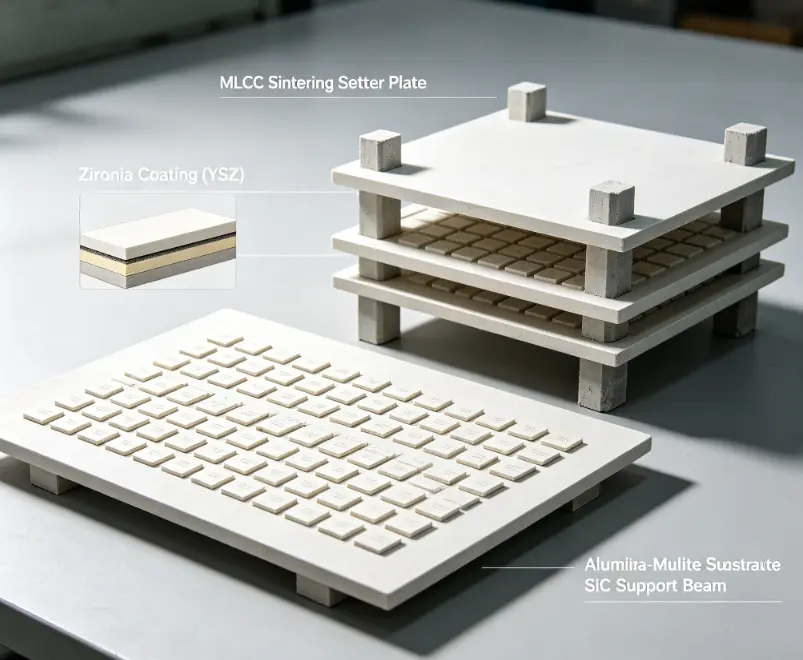
For the dominant zirconia-coated composite setter architecture, the coating is the most critical — and most difficult — element to manufacture reliably. The coating, typically 50 μm to 200 μm thick, must be:
Dense, with minimal open porosity, to prevent barium vapor penetration.
Well-bonded to the substrate, with no delamination after repeated thermal cycling.
Free of pinholes, cracks, or uncoated spots, since any breach exposes the reactive alumina-mullite substrate beneath.
Chemically pure, with no contamination from the coating process itself.
Atmospheric plasma spraying (APS) is the most common coating method, but it requires precise control of plasma power, powder feed rate, spray distance, carrier gas flow, and substrate temperature. Even small deviations can produce coatings with excessive porosity, poor adhesion, or residual stress. The substrate must also be carefully prepared — typically by grit blasting to create a mechanical anchor profile — and preheated to reduce thermal shock during the initial spray passes.
A major persistent challenge is thermal expansion mismatch between the zirconia coating (approximately 10–11 × 10⁻⁶/K) and the alumina-mullite substrate (approximately 5–8 × 10⁻⁶/K). This mismatch generates residual stresses at the interface during cooling from coating deposition temperatures, which can lead to coating spallation after repeated MLCC firing cycles. Manufacturers address this through graded or bond-coat layers — intermediate compositions that smooth the thermal expansion transition — but these add process complexity and cost. Alternative coating methods, including electron-beam physical vapor deposition (EB-PVD) and sol-gel dip coating, are being explored but have not yet displaced plasma spraying for high-volume production.
Challenge 6: Thermal Shock Reliability and Service Life
MLCC setter plates must survive hundreds to thousands of thermal cycles between room temperature and 1300°C–1350°C without cracking, warping, or coating degradation. Validating this reliability requires accelerated thermal cycling tests — typically quenching plates from 1000°C into room-temperature air or water — followed by microscopic examination for crack initiation. The difficulty is that thermal shock failure is probabilistic and highly sensitive to microscopic flaws: a single subsurface grinding crack, a coating pinhole, or a grain-boundary impurity can serve as a fracture initiation point that only manifests after dozens of cycles.
Manufacturers must therefore implement statistical process control across every manufacturing step, from powder inspection to final coating quality, and maintain comprehensive traceability for each plate. Even with these controls, service life varies significantly between plates, and MLCC manufacturers typically replace entire sets of plates on scheduled intervals rather than waiting for individual failures.
Challenge 7: Cost Control in a High-Precision Process
Perhaps the most fundamental manufacturing challenge is economic. Every step described above — high-purity powder, precision forming, long-cycle sintering, diamond grinding, plasma coating, and 100% inspection — adds cost. Yet MLCC manufacturers operate on extremely thin margins and exert relentless downward pressure on setter plate pricing. The most successful manufacturers are those that can achieve high yield (typically 95% or better for finished plates), optimize kiln utilization through intelligent loading patterns, and develop proprietary coating or forming technologies that reduce material consumption without sacrificing performance.
Conclusion
Manufacturing refractory kiln furniture for MLCC sintering is a masterclass in precision ceramic engineering. The challenges span the entire production chain — from sub-parts-per-million impurity control in raw powders, through the thermomechanical intricacies of sintering large thin plates, to the nanoscale quality requirements of zirconia barrier coatings. Each difficulty compounds the others: a slight powder impurity may cause abnormal grain growth, which increases grinding difficulty, which introduces subsurface cracks, which ultimately reduce thermal shock life. The manufacturers that excel in this field are those that treat the entire process as an integrated system rather than a sequence of independent steps — and that invest continuously in process analytics, automation, and materials science. As MLCCs continue toward higher layer counts and thinner dielectric layers, the manufacturing tolerances for setter plates will only tighten, making this a field where technical mastery directly translates into market leadership.