
Silicon Carbide Saggers vs. Corundum (Alumina) Saggers: A Comprehensive Comparison for High-Temperature Industrial Applications
Material Composition and Basic Characteristics
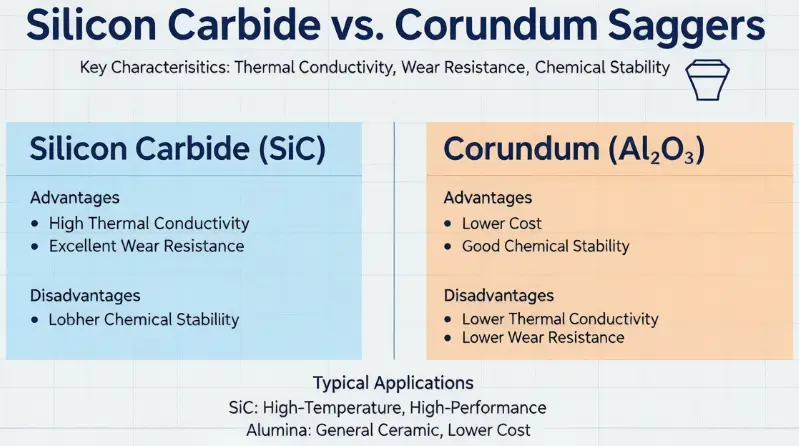
Silicon Carbide saggers are typically manufactured from reaction-sintered SiC, recrystallized SiC (RSiC), or nitride-bonded SiC. SiC is a covalent-bonded ceramic with extremely high hardness (Mohs 9.2), low thermal expansion, and outstanding thermal conductivity. It is available in various grades, with sintered SiC offering the highest purity and chemical inertness.
Corundum or alumina saggers are predominantly made from high-purity α-Al₂O₃ (typically 90%–99%), sometimes blended with minor amounts of mullite or silicate binders to improve workability. Corundum has an ionic bonding structure, a very high melting point (~2050°C), excellent chemical inertness in oxidizing atmospheres, and good resistance to acidic slags, but it is relatively brittle and has modest thermal shock resistance.
Maximum Service Temperature
One common misconception is that SiC always withstands higher temperatures than alumina. In fact, high-purity corundum saggers can be used continuously at 1600–1750°C, with short-term exposure up to 1800°C, whereas most SiC-based saggers have a practical upper limit of 1550–1650°C in oxidizing atmospheres due to progressive surface oxidation forming a SiO₂ layer. Above 1650°C in air, SiC may suffer from active oxidation or accelerated degradation. However, in neutral or reducing atmospheres (e.g., N₂, Ar, CO), SiC can retain structural integrity up to 1700–1800°C. Therefore, for ultra-high-temperature applications (>1700°C) in air, high-purity alumina is often preferred; for fast-firing below 1600°C, SiC is superior.
Thermal Conductivity and Firing Efficiency
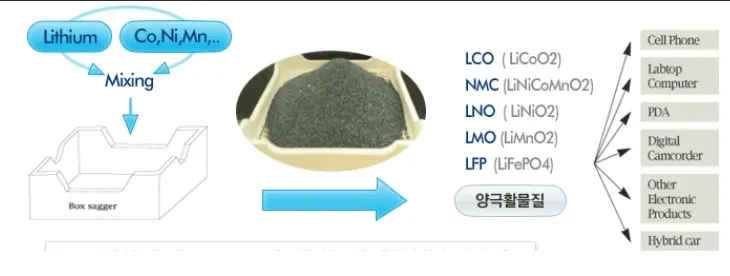
Thermal conductivity is one of the most decisive differentiators. SiC exhibits thermal conductivity in the range of 80–180 W/(m·K) depending on grade, while dense alumina typically measures 20–30 W/(m·K). This 4–6× advantage means SiC saggers transfer heat rapidly and promote highly uniform temperature distribution inside the loaded sagger. In push-plate kilns or roller hearth kilns firing lithium battery cathode materials (LFP, NCM), SiC saggers enable shorter heating/cooling cycles, reduce thermal gradients, and increase throughput—often by 15%–30% compared with alumina.
By contrast, alumina saggers act more as thermal insulators. Slower heat penetration can be disadvantageous for productivity but may benefit certain delicate ceramic glaze firings where overly rapid heating causes warping. Nevertheless, in high-volume continuous production, the slower cycle time of alumina saggers is usually a drawback.
Thermal Shock Resistance and Service Life
Thermal shock resistance—the ability to survive rapid temperature changes without cracking—is closely related to thermal conductivity and the coefficient of thermal expansion (CTE). SiC has a low CTE (≈4.0–4.5 × 10⁻⁶ /°C) and high thermal conductivity, giving it excellent resistance to thermal shock. SiC saggers routinely survive thousands of rapid heat-cool cycles in push-plate or batch kilns and typically outlast alumina saggers by 2 to 5 times under comparable conditions.
Alumina has a higher CTE (≈7.0–8.5 × 10⁻⁶ /°C) and lower thermal conductivity, making it more susceptible to micro-cracking under abrupt thermal cycling. Repeated firings above 1300–1400°C with fast ramps often lead to edge spalling or through-cracks in alumina saggers, especially in top-loading batch kilns. To mitigate this, manufacturers sometimes produce alumina-mullite composite saggers, which improve thermal shock resistance at the expense of maximum service temperature.
Mechanical Strength and Load-Bearing Capacity
At elevated temperatures, SiC retains high flexural strength (300–450 MPa at room temperature, with minimal creep deformation below 1500°C under load). This allows SiC saggers to be made thinner and lighter while supporting heavy powder loads, increasing effective kiln packing density and reducing heat storage in the Kiln Furniture system.
Corundum saggers are also strong at ambient temperature (cold crushing strength 150–250 MPa) but are more prone to high-temperature creep and deformation under sustained compressive loads above 1400°C. Their higher density (3.5–3.9 g/cm³ vs. SiC's 2.8–3.1 g/cm³) also makes them heavier to handle and imposes greater load on kiln car structures.
Chemical Stability and Contamination Risk
For high-purity applications—particularly lithium battery cathode material sintering—contamination from sagger constituents (Fe, Na, K, Si) is a major concern. High-purity sintered SiC is extremely chemically inert in both oxidizing and reducing atmospheres and introduces negligible impurities into the product. It resists attack by most molten salts, alkalis (moderate), and metal oxides, though prolonged exposure to strong oxidizing alkali vapors above 1000°C can slowly degrade the protective SiO₂ film.
Alumina saggers are chemically stable in oxidizing atmospheres and resistant to acid slags, but they may slowly release trace sodium or iron impurities—particularly if the raw material contains fluxing agents—which can discolor or dope sensitive electronic ceramics or cathode powders. Additionally, alumina is vulnerable to reaction with alkali metal vapors forming β-alumina or nepheline-type phases, which accelerates surface degradation.
In summary: SiC is preferable for high-purity, contamination-sensitive processes; alumina is acceptable for general ceramics and non-critical calcination where minor impurity pickup is tolerable.
Atmosphere Compatibility
SiC performs well in both oxidizing and reducing/inert atmospheres, provided a protective SiO₂ film can form in oxidizing conditions. In strongly oxidizing air above 800–1000°C, passive oxidation creates a protective silica layer; however, in the presence of water vapor or active oxidation regimes (very low oxygen partial pressure at high temperature), mass loss can occur. Nitride-bonded or recrystallized SiC grades offer improved oxidation resistance.
Alumina is ideally suited to air or oxidizing atmospheres and is less sensitive to oxygen partial pressure variations, but it is not recommended for strongly reducing atmospheres containing carbon or metallic vapors that could induce reduction reactions or carbothermal reduction at the surface.
Cost Considerations and Total Cost of Ownership
Upfront, alumina saggers are typically 40%–60% less expensive than SiC saggers of comparable size, making them attractive for small-scale operations, R&D labs, or low-cycle applications. However, when factoring in shorter lifespan, higher breakage rate under thermal cycling, slower firing cycles, and more frequent replacement downtime, the total cost of ownership (TCO) of alumina can exceed that of SiC in high-throughput industrial settings.
SiC saggers, despite higher capital cost, often deliver lower cost per firing cycle due to 2–5× longer life, faster turnaround, reduced reject rates from contamination or uneven heating, and less unplanned downtime. For large-scale battery material or advanced ceramic production, SiC is increasingly regarded as the more economical choice over the lifecycle.
Typical Application Recommendations
-
Choose SiC saggers for: Lithium-ion battery cathode (LFP/NCM) sintering, fast-fire push-plate or roller hearth kilns, applications requiring rapid thermal cycling, high-purity electronic ceramics, heavy powder loads, and processes in inert/reducing atmospheres.
-
Choose Corundum/Alumina saggers for: Ultra-high-temperature firing (>1700°C) in air, laboratory-scale calcination, traditional ceramic glaze firings with slow ramp rates, applications with tight initial budget constraints and moderate cycling frequency, and oxidizing atmospheres where alkali attack is minimal.
Conclusion
Neither Silicon Carbide nor Corundum saggers are universally "better"—each excels in different domains. SiC dominates in thermal shock resistance, thermal conductivity, cycle speed, contamination control, and long-term durability, making it the premium choice for modern high-throughput, high-purity sintering lines. Corundum saggers remain valuable for their higher continuous-use temperature ceiling in air, chemical inertness to acids, and lower initial purchase price, particularly in lower-cycle or ultra-high-temperature niche applications. A well-informed selection, aligned with firing profile, atmosphere, purity requirements, and total cost of ownership, is essential to optimizing both product quality and operational efficiency.